In addition to helping process school memories, Reschool Yourself involves raising questions about the practice and philosophy of traditional schooling in general. I want to be clear that I love and respect all of my schools, and although I’m using examples from their campuses, I’m talking about school in general. I’m truly curious about why schools tend to operate the way they do, and what changes are possible within their circumstances.
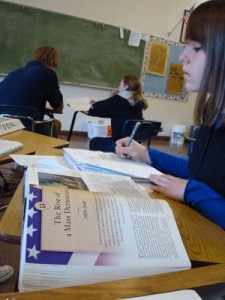
This week, I’ve noticed a few underlying assumptions about students — which I’ve noticed at other schools, too — that give me pause. Whether stated or not, they seem to be taken for granted, and include the following:
1. Students wouldn’t come to school if they didn’t have to and are therefore thrilled to have days off.
My observation: The general merriment around the Veteran’s Day holiday. When one teacher reminded the students about it, one guy said sarcastically, “Oh yeahhh, I almost forgot. It’s not like I’ve been looking forward to it for weeks.”
2. They hate homework.
My observation: Groans and complaints when teachers give too much homework, and teachers’ statements like, “If we take our quiz Friday, then you’ll have no homework over the weekend!”
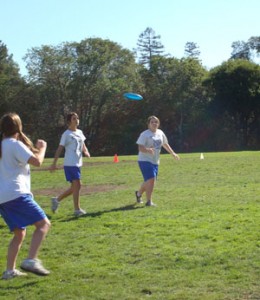 3. Beginning their junior year, they have academic priorities that are more important than physical fitness.
My observation: P.E. is required only of freshmen and sophomores. This article from The Onion, “Majority of Americans Never Use Physical Education After High School,” might explain why.
4. They must follow guidelines that don’t bind adults.
My observation: I’m going to single out one my former (and favorite) teachers by sharing this observation. When I was snapping photos in the hallway with my digital camera, he tapped me on the shoulder and asked me to hand over the camera. When I turned around and he realized who I was, he looked sheepish, apologized to me, and said lightly to the students nearby, “She’s authorized.”
5. Everyone expects that they won’t remember or use most class material after they graduate.
My observation: Teachers and students tend to be surprised that I remember any of the high school curriculum at all. In order to show how poorly a typical adult does when quizzed on curriculum, I’m willing to risk personal embarrassment. While shadowing in both middle and high school, I’ve taken several quizzes cold, without having studied or attended class. I’ll write a separate post about this experience, but I can tell you that I remember very, very little of middle and high school material in most subjects. Even the fourth and fifth grade lessons on photosynthesis and long division would have stumped many adult professionals. Why do students have to spend so many hours memorizing this material if they’re expected to forget it shortly after being tested on it?
Teachers, when asked, will often admit freely that they know most students won’t ever do say, problems with cosines or joules, after graduation. In fact, one of my teachers said these three surprising things to me:
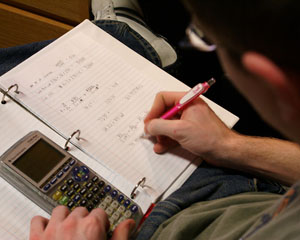 One: “Most people won’t use algebra and calculus after high school.” He added that they’re used mostly for specific tasks within fields like engineering.
Two: “It’s a shame that students are required to take Algebra II in high school” (usually to meet the admissions guidelines for the University of California.) He’d rather they invest the time in studying something of interest to them.
Three: “During my senior year of college, a professor told me that I’d forget 90 percent of what I learned in college two years after graduating. Well, I swore that I’d prove that professor wrong, and I did: I forgot 90 percent of the material a year and a half after graduating.”
Think back to all that material on all those tests you studied for, even in subjects that interested you. Honestly, how much of it can you recall on the spot, and how useful is it to be able to do that? If you happen to be an E.R. doctor, it might be good to know the anatomy of the respiratory system without having to Google it, but the rest of us normally have the luxury of looking things up if the need arises.
I’m sure that we’ve all had certain learning experiences that have sparked our interest, introduced us to new perspectives or new subjects; we may have even had teachers who helped us “learn how to learn,” which has become a popular saying. I’m curious about the situations where this happened for us, and how we can have more of those and less of the stuff that we did because we had to. Perhaps there’s a way where, from an early age, we can each spend our time in school on what we love to do.
Inspired by my observations this past week, I’d like to pose a few questions to you. I do so with the utmost respect to my teachers, and to teachers everywhere. I’d like for readers — teachers, students, and alumni alike — to remember their own experiences and answer whichever questions they like by posting a comment.
1. What elements would your ideal high school have, so that you would have attended purely out of interest and enjoyment?
2. What impact did homework have on you?
3. Did it make sense to you to have to take P.E. only until a certain age? What impact did P.E. have on you?
4. Which rules at your school applied only to students and not to adults?
5. What did you study in school that you find useful today, and what is not very useful? How much material can you recite from memory, versus what you look up as needed?
1. I would love for high school to be place to go and have guidance from teachers in using past academic work to help understand current events and trends with an emphasis on problem-solving. Like, understanding the terms ‘economic crisis’ and ‘bailout’ in the news with past examples of government’s relationship with commerce, progressive-era antitrust laws, things like that. There’s a lot of drilling of facts without guidance about how to apply that to real circumstances.
2. Homework had little impact on me. I would say that I did about 50% of the required reading for English classes. Lord of the Flies, yes; Jane Eyre no. I’d hurriedly do things like worksheets immediately before the bell rang.
3. My junior year P.E. class consisted of the whole group walking out to random spots around campus and hanging out for an hour. I think that P.E. should be a holistic approach to finding fun physical activity and incorporating a positive approach to eating natural food.
4. One time we watched ‘The Scarlet Letter’ with Demi Moore and Gary Oldman in history class. When it came time for a sex scene, instead of fast forwarding the tape the teacher just swiveled the TV around until it didn’t face the students, watched the whole scene, and then swiveled the TV back. WTF.
5. Because I didn’t take any Math or English courses in college, high school remains my chief exposure to those disciplines. I use proportions frequently for design measurements, but nothing more advanced than algebra. I’m grateful to my English classes for exposure to the English canon, including a strong focus on Southern, African-American writers. I have a pretty strong foundation in history, especially U.S. history, from an excellent A.P. course. I draw from that immensely in following basics about how levels of government work, and trying to understand current U.S. situations in light of history.
1) I actually think that the high school I attended had a lot of the qualities I would like in my ideal school. It was a hard school academically, but ran a lot like a university. We operated on a modular scheduling system, which meant that the school “week” was actually a 10-day rotation called a cycle. Some classes met 4 times a cycle, some met 6 or 8 times a cycle. The day was split up into 16 “mods” that were about 20 minutes long, and classes would be scheduled over 2 or 3 mods. Some days, I would have 7 classes with just an opening for lunch but other days I would have only 1 or 2 classes. The time I wasn’t in class, I could do pretty much whatever I wanted: Go to study hall, get help from a teacher if he or she wasn’t teaching a class or go work on things related to extra-curricular activities. It was great for time-management purposes and really fostered an open relationship between teachers and students. It also allowed me more time to focus on things I enjoyed, like theater, music and writing.
One thing I would like to see more of in schools is allowing students to schedule their classes around an internship or other career-related training. My school would do this on a case-by-case basis, but it was widely known that you wouldn’t qualify for this privilege unless you were high ranking. Don’t all students need the opportunity to explore their talents and career possibilities before college?
2) I had very little homework in general, other than preparing for the next class by reading ahead and reviewing the previous lesson. I had no graded assignments other than papers and tests, which was good in some ways because it taught me to choose to be responsible so that I could participate in class rather than doing it because I would fail.
3) I think it does make sense to take P.E. until a certain age, and I actually think it should either stop completely or broaden considerably in high school. In high school, especially my junior and senior years, academics were more important than gym class. That’s just a fact in the traditional school system, and particularly in a college-prep environment: Between the SAT and ACT, maintaining grades and applying for college, gym is not a priority. P.E. classes are so ineffective anyway that they would never promote physical fitness in someone who didn’t stay active outside school as well. If P.E. is to continue into high school, it should be broadened to include nutrition classes, dance classes, fencing, kickball, etc…whatever the student wants.
4) First of all: Darren, that is the best story ever.
Besides the uniform policy, the only rules that come to mind governed cellular phones, cameras, etc. Teachers did have the option to skip out on the monthly Mass, but I’m pretty certain that anyone who was adamantly opposed to going could find something else to do for an hour as long as she cleared it first with her adviser.
5) Having worked as a copy editor, I can say that a lot of the material that I studied in high school is still relevant to me. This is particularly true for all things literature, math (through algebra II), chemistry, biology, Spanish and history. I need to know a bit about a lot of different subjects for my job, and I’m glad that I have the knowledge.
I think I maintained most of the literature and history information because that’s what interested me most. Despite having gone up through my senior year in all these subjects, I only know the basics in biology, chemistry, Spanish and math (the stuff you might learn in the first semester of a particular course), and that’s hazy at best. I know enough to know what I need to look up to find the answer, anyway. The biggest waste of my time in high school was calculus. I wanted to take statistics because it would be more relevant to my chosen field, but got pushed into calculus by the math department because I was a year ahead and that was the “track” I was on. I didn’t need it, and I regret devoting any time to it because it essentially subjected me to nine months of mind-blowing frustration. I still couldn’t tell you anything about calculus, not even the basics.
1. What elements would your ideal high school have, so that you would have attended purely out of interest and enjoyment?
I too would’ve loved to have a more career based high school. There weren’t many computer classes when I was in high school (I graduated ’02) besides two measly programming classes. Due to my AP schedule, I couldn’t even take those! I wish the emphasis wasn’t so much on AP classes either…it seemed the more you had, the better you ranked in the scheme of things. Maryknoll had the Essential Learning program which (if I remember correctly) had a choice of 2 “core” classes and 2 electives. I enjoyed it and didn’t feel hurried to go from class to class. When it came to foreign languages, it was really language immersion: every other day was a full day of Chinese and the other days were 4 hours of Chinese + an elective. It was fun but I think it would’ve been more effective if I had wanted to take Chinese.
2. What impact did homework have on you?
Not much. I was given time to do it in class, did some at home and whatever I couldn’t finish, you could find me on before school and in homeroom cranking away. I didn’t have that much come to think of it.
3. Did it make sense to you to have to take P.E. only until a certain age? What impact did P.E. have on you? No. We had PE until senior year: the first class focused on running 2 miles as a goal, the second class was not only 2 miles but other fitness goals and the third was based on finding physical activity in golf, bowling, etc. Needless to say, the third class was the best. I wish we could’ve had some yoga (maybe that’s a little too recent) or tennis. It’s sunny for like 300 days of the year ANYWAY. Although I enjoy running, I think it would’ve made more impact with me now if I had learned yoga or played tennis back then.
4. Which rules at your school applied only to students and not to adults?
Not being able to go off campus for lunch. I think that’s a big privilege in most high schools but …some students got busted for a knifing incident off campus (thanks class of 98). I remember the “tuck in your shirt” rule being huge (aka equaling detention).
5. What did you study in school that you find useful today, and what is not very useful? How much material can you recite from memory, versus what you look up as needed?
I remember SOHCAHTOA. No really, I think the most useful thing I learned in high school was not in the classroom. As a computer geek, I got to learn how to manage my time and other technical skills that I still use today. I guess the most useful subject matter I learned in school was math and science since it helped me later in college. We had to create a Senior Project in high school and that really helped with project and presentation planning.
You’ll think I’m crazy, but I believe almost all of these assumptions to be purely determined by cultural expectations (that is to say, false).
1. Students enjoy coming to school. It’s an environment that provides an identity. Even if it’s a negatively determined identity, it is stability and security. It’s always fun, even when it’s not, and God knows it’s better than the terrors of domestic and social life.
2. Students like homework; it’s a profound, meditative, spiritual experience, like a profane illumination. The fact that students complain about homework only proves that they do like it (we always complain about what we most love; ask anyone you know about their boyfriend, girlfriend, spouse, mother, etc.).
3. Sports are fun. Note that students even trapped indoors will invent fabulous competitive games to play with nothing more than scraps of paper.
4. This one is more true the other way around. Students can do pretty much whatever they want except chew gum and hit each other. Adults must always be polite, dress well, act boring, chew with their mouth closed, shake hands, wear a tie, act polite, be sensitive, do their paperwork, be obsequious and sycophantic, etc.
5. Studying is never about the subject matter; it’s about the practice and the process; it’s a communion with a higher spiritual plane. Who cares about the dates of magna carta? What one learns is the sublimation of the mind and spirit.